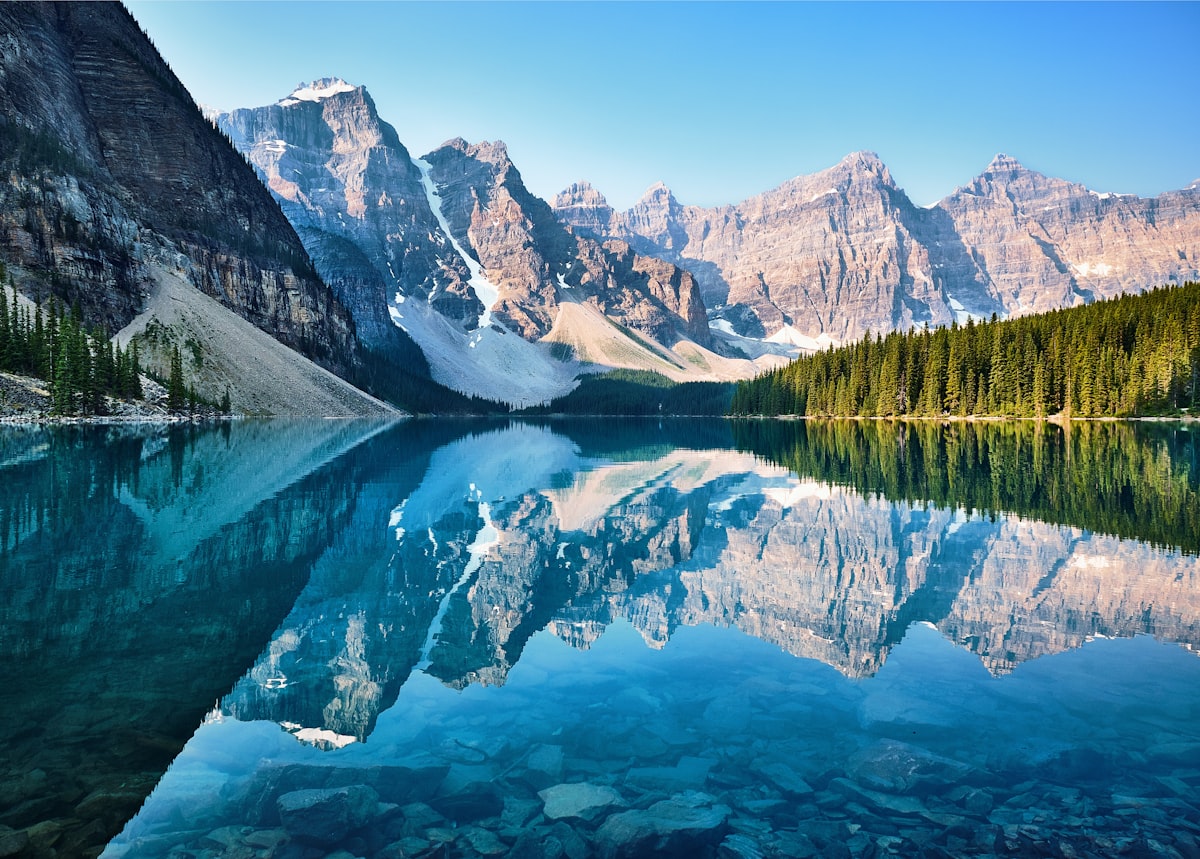
Canada holds more lake area than any other nation on Earth, boasting roughly 60% of the world’s natural lakes. From the soaring peaks of the Canadian Rockies to the rugged granite shores of the Canadian Shield, these bodies of water are celebrated for their vibrant turquoise hues and pristine clarity.
Whether fed by ancient glaciers grinding rock into fine silt or filtered through volcanic basins, here are five breathtaking Canadian lakes that offer unmatched scenic views.
1. Moraine Lake (Banff National Park, Alberta) — The Valley of the Ten Peaks
Situated 8.7 miles outside the village of Lake Louise at an elevation of 6,183 feet, Moraine Lake is arguably the most recognizable alpine lake in the Western Hemisphere.
- The Color Phenomenon: The lake’s vivid turquoise-cyan hue is caused by glacial rock flour (finely ground rock particles suspended in water) that refracts the blue-green wavelengths of sunlight as summer meltwater peaks in June and July.
- The Rockpile Viewpoint: Ascend the short, well-maintained Rockpile Trail to view the lake framed by the dramatic, jagged amphitheater of the Ten Peaks—a vista so iconic it was featured on the reverse of the Canadian twenty-dollar bill from 1969 to 1979.
- Access Note: To protect the fragile alpine ecosystem and reduce traffic congestion, Parks Canada closed Moraine Lake Road to private vehicles. Access is now managed via official Parks Canada shuttles and commercial tour operators, which must be booked in advance.
2. Garibaldi Lake (Garibaldi Provincial Park, British Columbia) — The Volcanic Barrier
Tucked beneath glacier-capped peaks between Squamish and Whistler in British Columbia’s Coast Mountains, Garibaldi Lake sits behind an immense natural volcanic dam known as “The Barrier.”
- The Hike: Unlike lakes accessible via vehicle turnouts, reaching Garibaldi Lake requires a moderate 11-mile (18 km) round-trip hike through old-growth Douglas fir and western red cedar forest, climbing 2,600 vertical feet.
- The Reward: Hikers emerge onto pristine alpine shores framed by Mount Garibaldi and the colossal volcanic monolith of The Black Tusk. The crystal-clear turquoise waters reflect snow-clad cirques with mirror-like clarity.
- Best Season: July through September, when alpine wildflower meadows around nearby Black Tusk and Panorama Ridge burst into vibrant bloom.
3. Emerald Lake (Yoho National Park, British Columbia) — Serenity in the Rockies
Discovered in 1882 during the construction of the Canadian Pacific Railway, Emerald Lake is the largest body of water in Yoho National Park, nestled just west of the Continental Divide.
- The Atmosphere: Surrounded by the President Range and Mount Burgess, Emerald Lake is calmer and less commercialized than its Banff counterparts. The intense emerald green coloration is especially striking during calm morning hours.
- The Lakeside Loop: A gentle 3.2-mile (5.2 km) trail loops entirely around the lake basin, transitioning from open mountain views to a unique microclimate forest containing ancient western hemlock and western red cedar trees.
- Canoe Rentals: Rent a hand-crafted wooden canoe from the historic Emerald Lake Lodge to paddle across calm waters toward the alluvial fan at the far end of the basin.
4. Lake Superior (Lake Superior Provincial Park, Ontario) — The Inland Sea
The world’s largest freshwater lake by surface area, Lake Superior (Gichigami in Ojibwe) feels less like a lake and more like a vast, wild inland ocean.
- The Agawa Rock Pictographs: Located along the rugged granite shoreline of Lake Superior Provincial Park, ancient red ochre pictographs painted centuries ago by Ojibwe travelers are preserved directly on towering granite cliff faces above the water.
- Caribou Island & Coastal Cliffs: The clarity of Superior’s cold, nutrient-sparse waters allows underwater visibility exceeding 30 feet, revealing submerged granite boulders and historical shipwrecks.
- Katherine Cove: A protected crescent beach featuring fine sand and shallow, crystal-clear water where visitors can safely wade along the rugged Trans-Canada Highway route.
5. Maligne Lake (Jasper National Park, Alberta) — Spirit Island Majesty
Spanning 14 miles in length, Maligne Lake is the largest naturally formed lake in the Canadian Rockies, fed by the meltwaters of the Coronet Glacier.
- Spirit Island: Accessible only via boat tour or a long backcountry paddle, Spirit Island is a world-famous spiritual and photographic icon—a tiny cluster of fir trees on a rocky spit surrounded by three glaciers and towering limestone walls.
- Wildlife Encounters: The road to Maligne Lake passes through prime Canadian wilderness where black bears, grizzly bears, moose, and bighorn sheep are frequently spotted grazing along alpine roadside meadows.
Respecting Canadian Wilderness Ecosystems
When visiting sensitive northern lake basins:
- Never Introduce Invasives: Clean, drain, and dry all watercraft, paddles, and footwear to prevent the spread of invasive zebra mussels and whirling disease.
- Pack Out Everything: High-altitude alpine environments take decades to decompose organic waste (including fruit peels).
- Carry Bear Spray: Banff, Jasper, Yoho, and British Columbia parks are active grizzly and black bear habitats. Carry bear spray on your belt, not buried in your backpack, and understand how to deploy it.
If you are planning an extended road itinerary across North America, combine these glacial wonders with our guide to iconic scenic road trip drives and explore our full Travel & Places archive.